Defense Training AI
Photorealistic synthetic imagery for advanced military simulation and performance prediction.
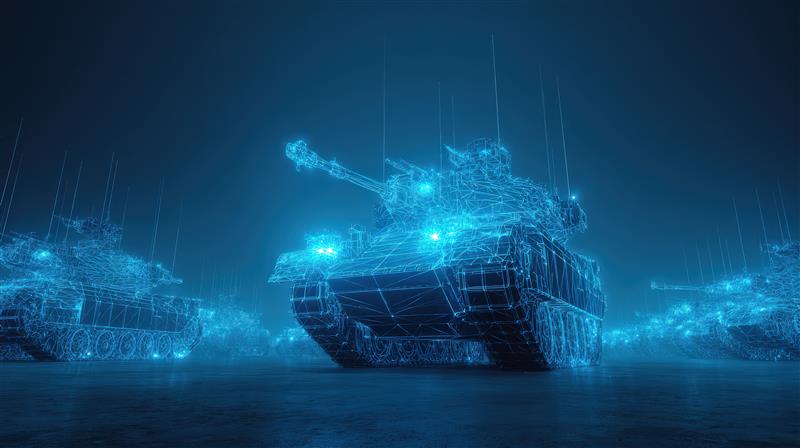
Defense training programs require highly realistic visual references for armored vehicles and battle tanks — assets that are costly, restricted, or impossible to photograph at scale. Without a scalable way to generate accurate military imagery, simulation and training initiatives were limited in scope and fidelity.
An AI-powered image generation system trained to produce photorealistic visuals of armored vehicles and battle tanks from scratch. Built on a deep generative architecture and trained on tens of thousands of images, the system goes beyond visual output — linking generated imagery directly to predicted performance characteristics.
Generative Intelligence System
AI Image Engine
A Deep Convolutional Generative Adversarial Network (DCGAN) designed to produce high-fidelity military vehicle imagery for simulation and identification training.
Large-Scale Training
The DCGAN trained on a comprehensive dataset of 30,000 images, capturing the structural diversity required for accurate, military-grade output.
Detail-Preserving Architecture
Convolutional layers used without pooling to retain intricate structural details — essential for vehicle identification and feature analysis.
Metric Prediction
Regression models applied to the latent space to predict critical vehicle characteristics — such as armor thickness — directly from generated visuals.
Feature Classification
Decision tree analysis used to identify which visual features correlate with specific vehicle roles — adding an interpretability layer to the AI output.
Defense-Ready UI
Client requirements translated into intuitive, module-specific interfaces — ensuring defense personnel could interact with the system seamlessly.
Results & Outcomes
- Enabled scalable, on-demand generation of realistic military vehicle imagery for training use
- Established a novel link between visual representation and predicted performance metrics
- Reduced dependency on restricted or scarce real-world imagery for simulation programs
- Delivered both generative capability and analytical interpretability in a single system
Interested in a similar solution?
Let's discuss how we can build a data-driven advantage for your organization.
Work with me